How to check if a brand name is really available, not just the domain.
An available domain is not an available name. The handle can be taken, the package name published, the word can mean something unfortunate in Dutch, the domain can have a past, and someone can hold the trademark. This guide explains each of those checks and how to read the answers.
Updated September 202611 minute readSources: Google Chrome, IETF, Internet Archive
- kinds of evidence for one name
- 6kinds of evidence for one name
- platforms, registries and app stores
- 16platforms, registries and app stores
- languages screened for meanings
- 8languages screened for meanings
- visual contexts, down to 11 pixels
- 7visual contexts, down to 11 pixels
How do you check if a brand name is available?
Check six places, not one: social handles and developer platforms, every domain extension, meanings in other languages, what the domain was used for before, trademark registers, and how the name looks in use. Brand Check runs all six against one name and puts every answer on a single page.
Handles and platforms
X, Instagram, TikTok, Facebook and GitHub for the exact name, plus npm, PyPI, the app stores and community destinations.
Domain coverage
Every supported extension, verified by DNS and then by registry.
Cross-language screening
Spelling overlaps against dictionaries in eight European languages.
Domain history
Archive captures and Certificate Transparency records showing whether a real site ever lived here.
Trademark search
Official registers covering the US, the EU and participating offices.
Visual preview
The name set as a wordmark and pressure-tested at the sizes people actually read.
What will the name look like as a brand?
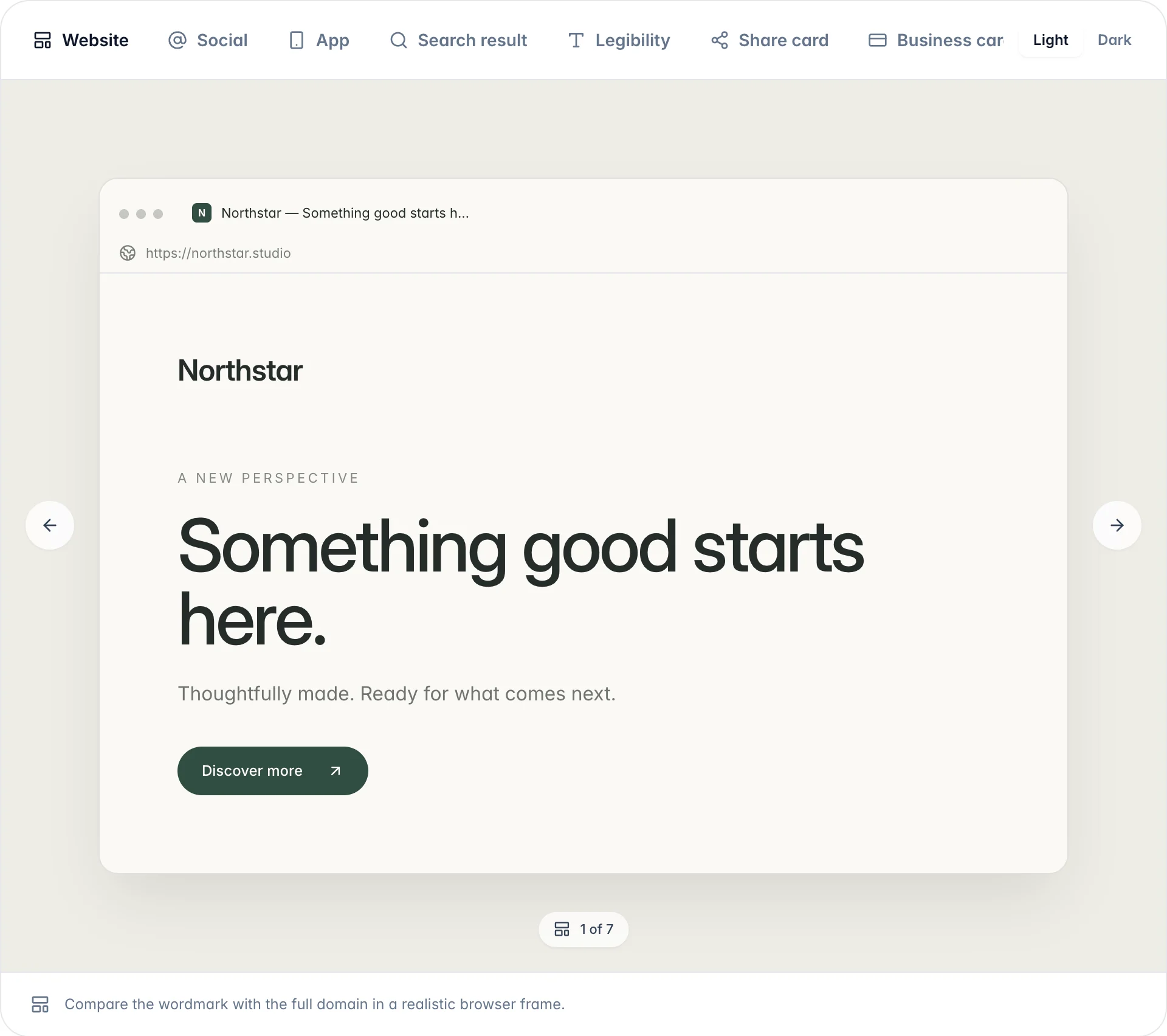
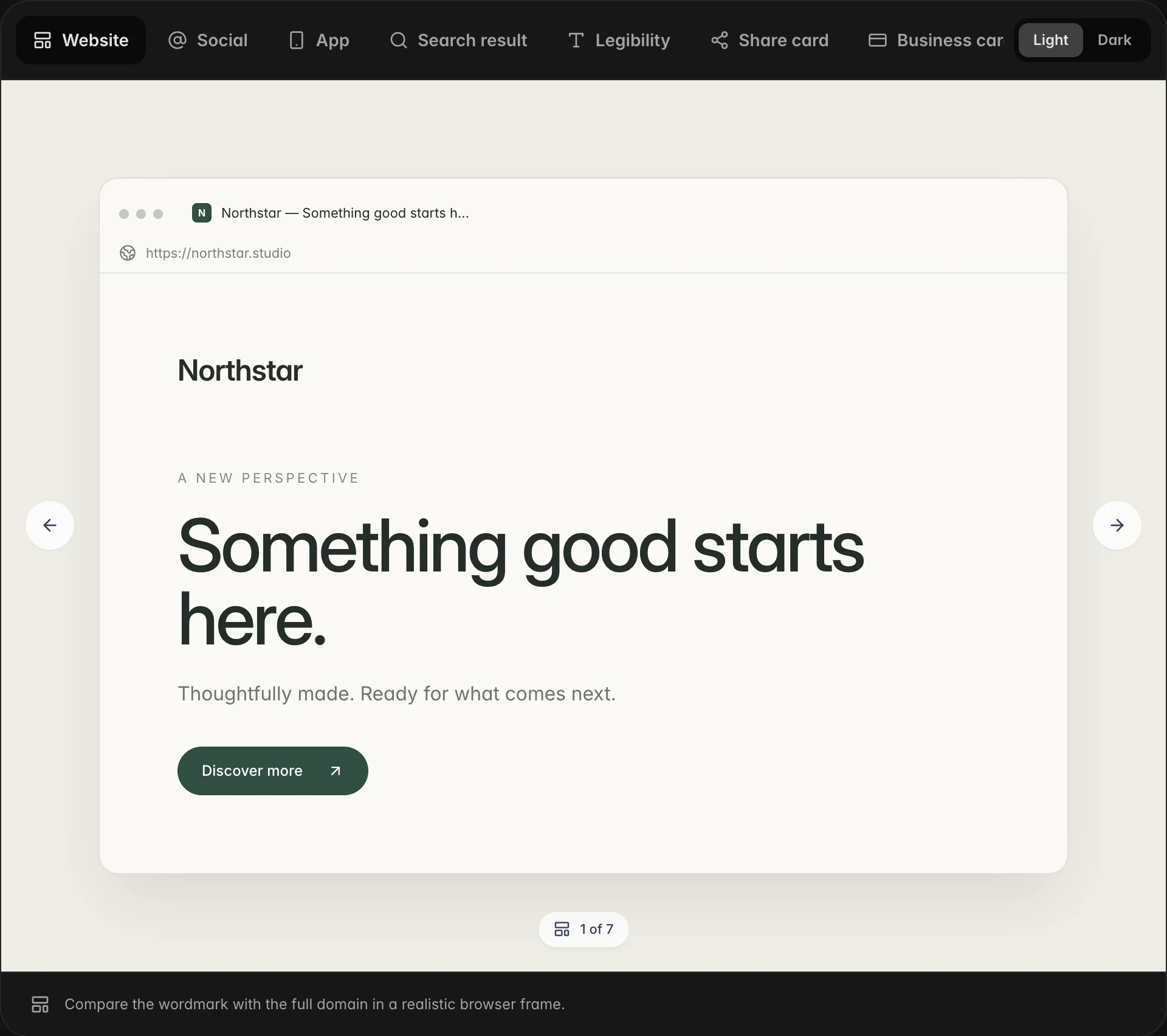
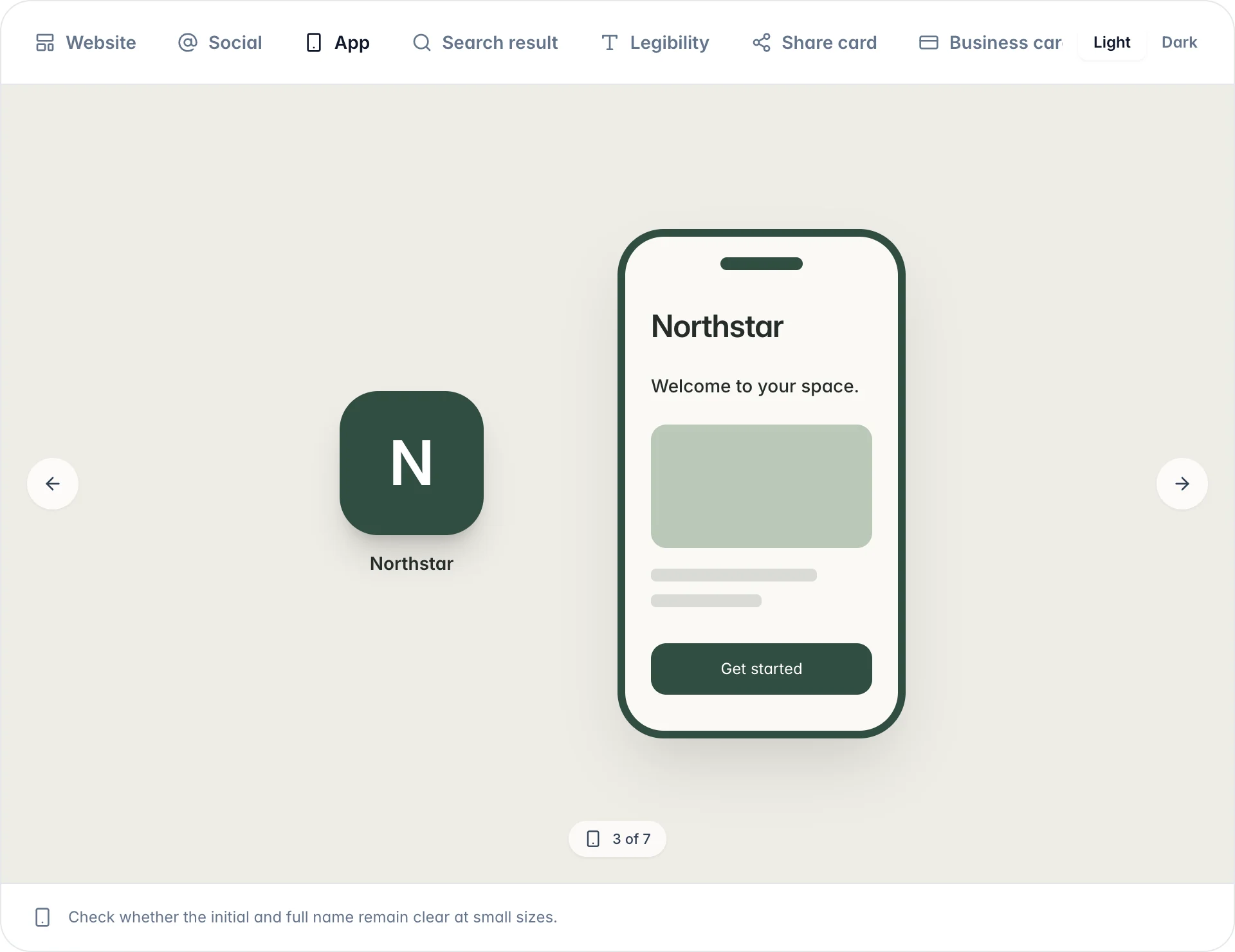
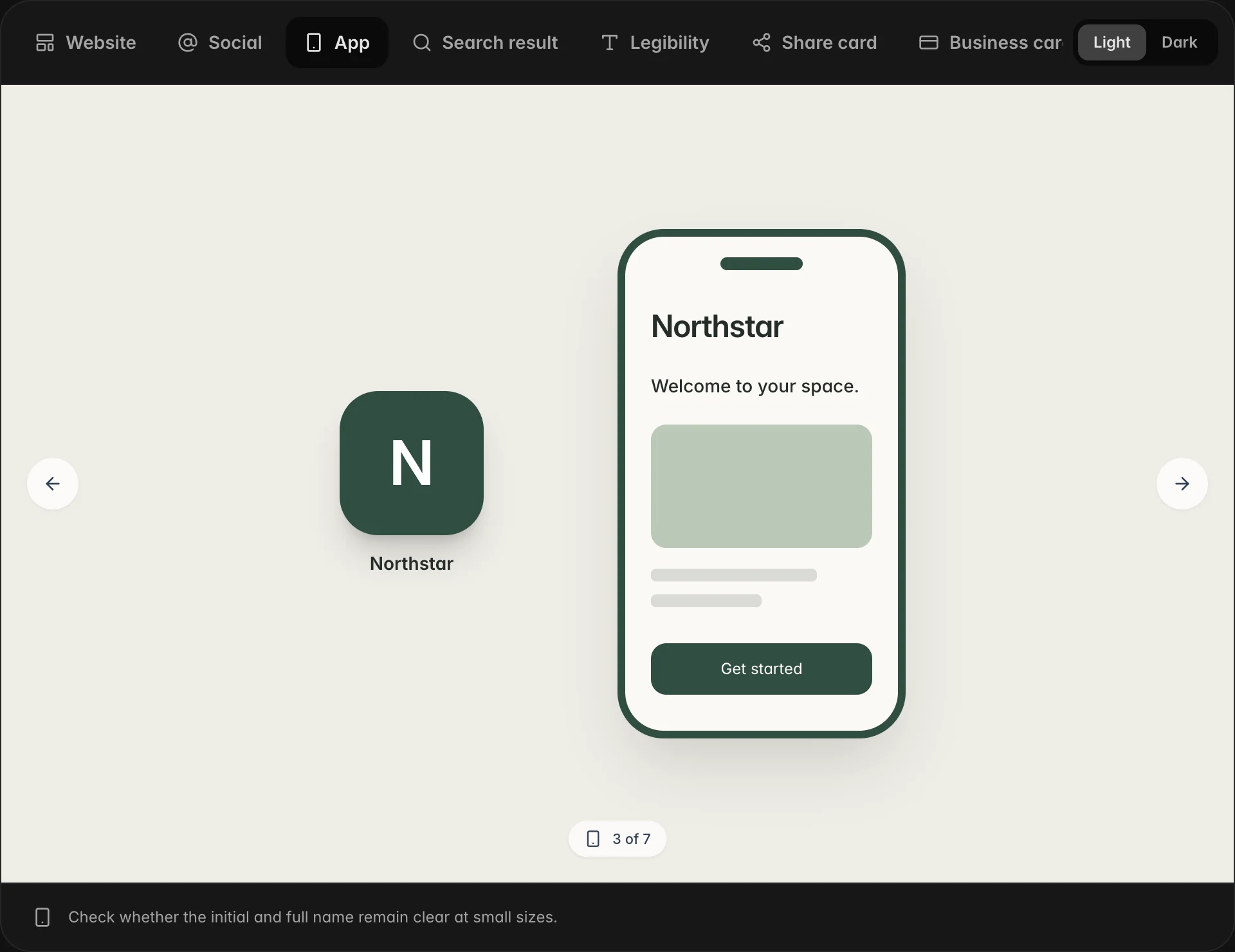
Brand Check sets it in the places people will meet it: a website, an app icon and screen, a social profile, a search result, a share card and a business card, in three typefaces, light and dark, and down to favicon size.
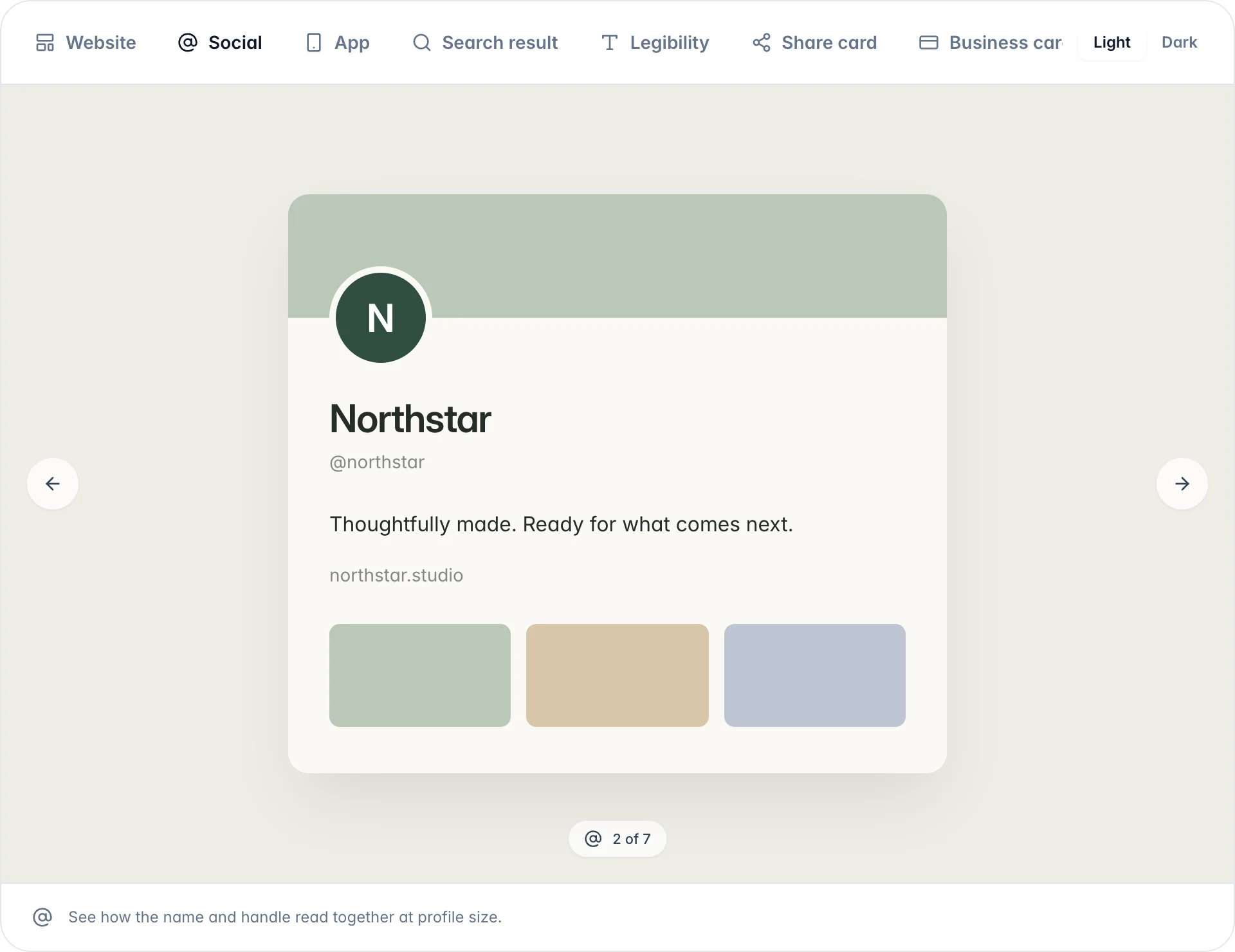
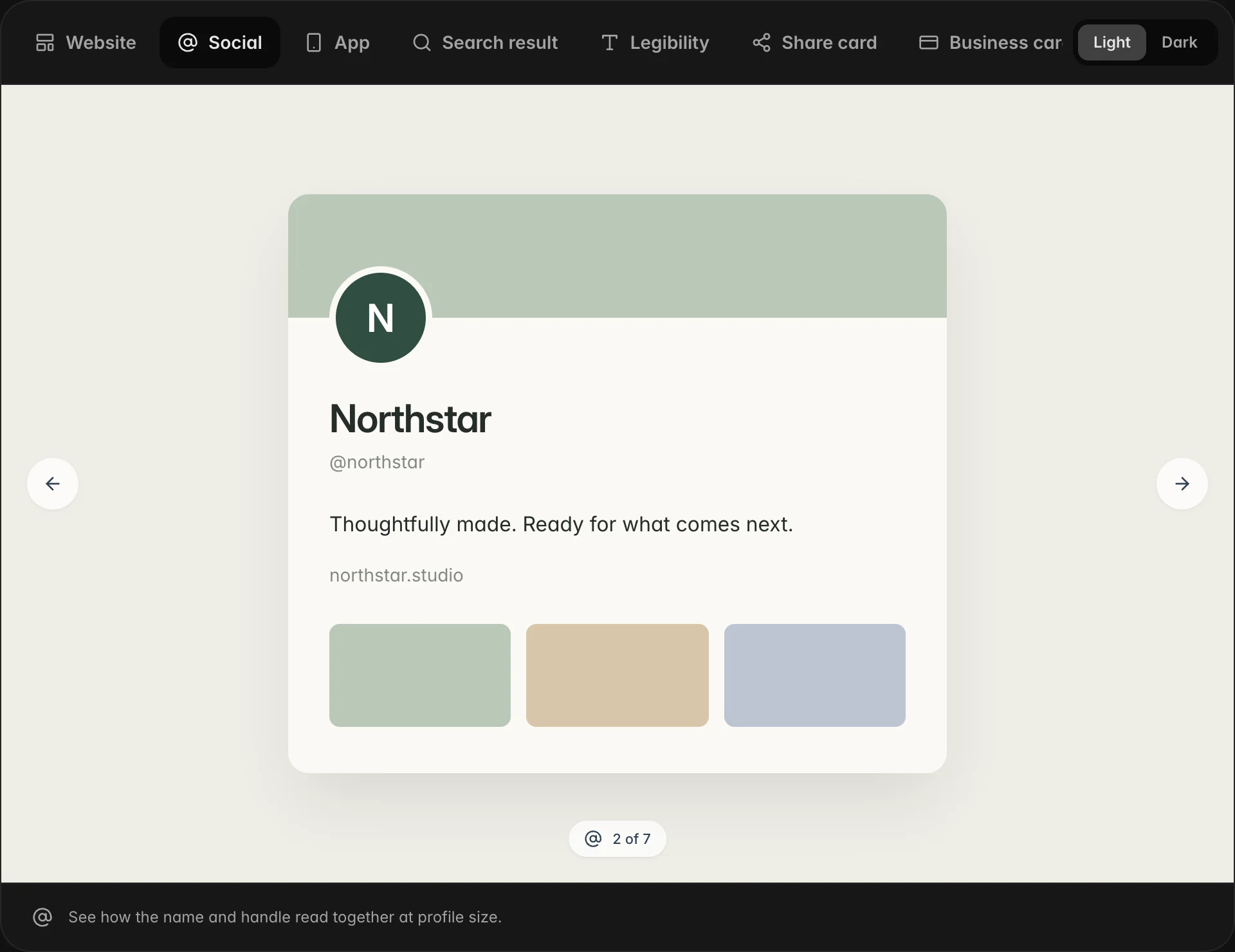
Where names break
A name judged only at hero size hides its problems until the favicon is made:
The size ladder
Headline and hero. Almost any name survives here.
Navigation and buttons. Letter spacing starts to matter.
Body text and table rows, where most people actually meet a brand.
Browser tabs, favicons and captions. This is where names break.
Is the name free as a domain in every extension?
Brand Check tests every supported extension in one pass: live DNS settles most of them in milliseconds, and the rest go to the authoritative registry record. Extensions with incomplete public data are marked for review instead of shown as free.
Tier 1
milliseconds
DNS delegation
A name serving live DNS records is in use. This pass clears most extensions immediately.
Definitively registered
Tier 2
slower, rate limited
Registry lookup
Everything the first pass could not settle goes to the authoritative registry record.
Registered, available, or needs review
For a whole list of names at once, use the bulk checker. For which extension to choose, read .com vs .io vs .ai.
Does my brand name mean something in another language?
Brand Check screens the name against dictionaries in Danish, German, English, Spanish, French, Italian, Latin and Dutch, and reports where the whole name, a part of it, or a word inside it is a real word. It is a prompt to look closer, not a verdict.
How a match is reported
The whole name is a dictionary word in that language.
A part of a compound name is a word on its own.
A word sits inside the name and may still be read there.
Screened languages
Plenty of strong brands are ordinary words in a language their customers do not speak. The point is to make that call deliberately, before the logo is finished.
How do you find out what a domain was used for before?
Look at two public records. Web archive captures show what the site looked like and when. Certificate Transparency logs list the publicly trusted HTTPS certificates issued for the name, a record that survives even when no page was archived, because Chrome only trusts certificates that were logged.
| What you see | What it usually means |
|---|---|
| No captures | The domain has probably never hosted a public site. A clean slate. |
| Captures over many years | A real site lived here. Worth checking what it was before you inherit it. |
| Captures that stop abruptly | A business that ended. The name may carry associations, good or bad. |
| Recent captures only | Recently active, so a drop or expiry may be more contested than it looks. |
Certificates
How long a certificate history the domain has. A long one means real infrastructure ran here.
Currently valid
Whether anything is still being renewed today, or whether the operation has wound down.
Observed hostnames
The subdomains that have appeared in those certificates: mail, api, staging, and the rest.
Buying a name that just dropped? Buying expired domains for SEO: what actually carries over covers what a previous owner can leave behind.
How do you check if a name is trademarked?
Search the official registers. Brand Check searches registers covering the United States, the European Union and participating global offices, groups matches as exact, close or related, and puts live exact conflicts first, each linked to the official record.
Match strength
The registered mark matches your name once formatting is normalised.
One contains the other, or they differ by only a few characters relative to length.
Returned as relevant by the register, but further away.
Ordering. Matches are ranked by strength first and then by whether the registration is still active, so a live exact conflict always sits above a lapsed one. Duplicates filed at multiple offices are collapsed to a single row.
This is not legal advice. A register search is the first step a professional takes, not the last. It cannot weigh your goods and services classes, unregistered rights, or likelihood of confusion. Drop obvious conflicts early, then take the survivors to a trademark professional before filing. Which kinds of names are easiest to register is in the Ideas guide.
Brand name check questions
Short answers to what people ask most about checking a brand name.
What does Brand Check actually check?
Six kinds of evidence about one name, side by side: social handles and developer platforms, every supported domain extension, spelling overlaps across eight European languages, public web archive captures and Certificate Transparency records, official trademark registers covering the United States, the European Union and participating global offices, and a visual preview of how the name reads in real contexts.
Does my brand name mean something in another language?
Brand Check screens the name against dictionaries in Danish, German, English, Spanish, French, Italian, Latin and Dutch, and reports where the whole name, a part of it, or a word inside it matches a real dictionary entry. These are spelling overlaps rather than translations, so treat them as a prompt to look closer rather than a verdict. Automated screening cannot catch slang, regional usage or context, so confirm important markets with a native speaker.
Can I check whether the name is free on npm, PyPI or the App Store?
Yes. The developer and community footprint check covers npm, PyPI, crates.io, Docker Hub, App Store and Google Play listings, plus Reddit, Discord, Telegram and ENS. Package registries are checked directly; the rest open with one click for you to confirm. A name with no public package is not necessarily a name you can publish, because registries reserve names and enforce similarity rules of their own.
What do Certificate Transparency records tell me about a domain?
Every publicly trusted TLS certificate is logged, and those logs are permanent. For a domain you are considering, they show how many certificates have been issued, how many are still valid, and which subdomains have been observed. A long certificate history with many hostnames means real infrastructure once ran here. Issuance alone does not prove a site was ever live or that the certificate was authorised.
Why do some social handles come back as inconclusive?
Because an HTTP 200 response alone proves nothing. Social platforms return a page for handles that do not exist, and they show login walls to signed-out visitors. A result is only reported as taken or open when the platform returns an explicit marker that says so. Anything ambiguous is reported as inconclusive with a link to verify by hand, rather than guessed at.
Is the trademark search legal clearance?
No. It is a text search against official registers, which is the first step a professional would also take, but it is not a clearance opinion. It cannot assess your goods and services classes, unregistered common-law rights, or likelihood of confusion in context. Use it to remove obviously conflicted candidates early, then take the survivors to a trademark professional before you file.
What is the difference between an exact, close, and related trademark match?
Exact means the registered mark is the same as your name once formatting is normalised. Close means one contains the other, or they differ by only a small number of characters relative to their length. Related means the register returned it as relevant but it is further away. Matches are ordered by strength first and then by whether the registration is still active, so live exact conflicts appear at the top.
Why does domain coverage check DNS before the registry?
A domain with live DNS delegation is definitively registered, and that answer arrives in milliseconds. Running that pass first resolves most extensions immediately and leaves a much smaller set for the authoritative registry lookup, which is slower and rate limited. Every result records which of the two confirmed it.
Further reading
Sources
- Google Chrome: Certificate Transparency policy
- IETF RFC 9162: Certificate Transparency
- Internet Archive: Wayback Machine
No name yet? Ideas generates candidates and scores them, and Domain Hub watches the ones you cannot have yet.
03.How do you check if a social media handle is available?
Ask for the exact handle and only trust an explicit answer. Platforms serve pages for handles that do not exist and show login walls to signed-out visitors, so Brand Check reports taken or not found only when the platform says so, and inconclusive otherwise, with a link to verify.
Handle result states
Not found: The platform returned its own not-found page for this exact handle.
Taken: The platform returned an explicit public profile marker for this exact handle.
Inconclusive: A login wall or an ambiguous response. Not guessed at, so verify by hand.
Not eligible: The name cannot form a valid handle on that platform at all.
The places a name gets taken quietly
Package registries and app stores are where a name is often already published by someone who never registered a domain or a handle. If the product ships a library, a CLI or an app, these names matter as much as the .com.
Packages and apps
Package registries answer directly. The app stores are searched by title.
Community and Web3
These open with one click so you can confirm the exact destination yourself.